

When a Typo Is Not Just a Typo: How a Typo Resulted in the Loss of a Priority Claim to a Provisional Application
In Enanta Pharmaceuticals, Inc. v. Pfizer, Inc., No. 2025-1427 (Fed. Cir. June 23, 2026), the US Court of Appeals for the Federal Circuit (CAFC) was faced with determining whether an alleged typographical error in a provisional application prohibited the non-provisional application, which corrected the alleged typographical error, from receiving the priority date of the provisional application.

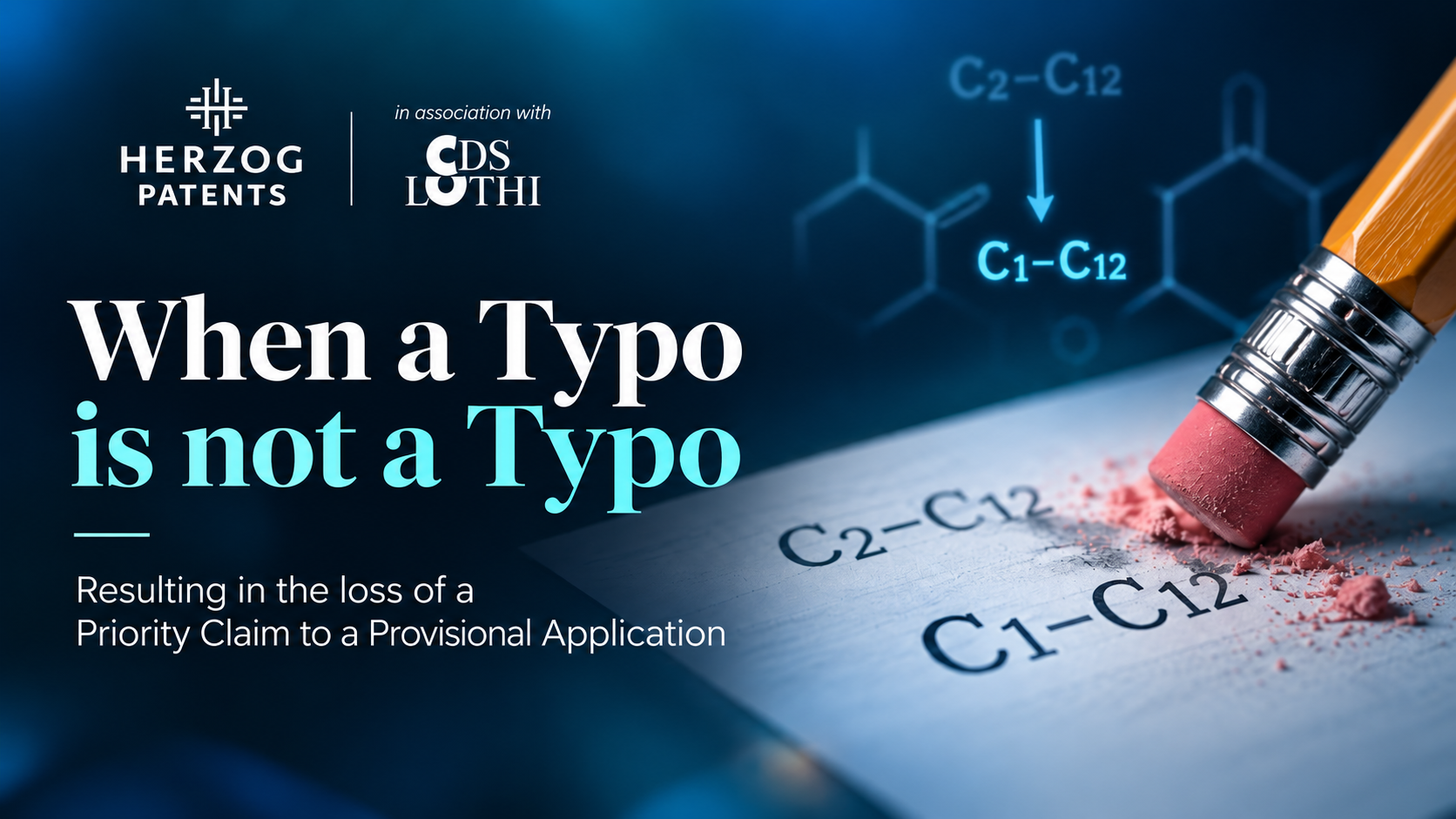
The facts of the case are straightforward. Initially, Enanta Pharmaceuticals (Enanta), the patentee, filed the underlying provisional patent application disclosing a substituent group of c2 to c12. After the filing of the provisional, but before a non-provisional was filed, which became the patent in suit, Pfizer (later the patent challenger), disclosed (publicly) a composition with the substituent group c1 to c12 in April 2021. Seeing this, the patentee filed its non-provisional application in July 2021, claiming the substituent group c1 to c12. The patentee sued Pfizer for infringement.
Pfizer moved for Summary Judgement, asserting that “c1” was not disclosed in the provisional application, such that the patentee’s claimed c1-c12 substituent group was not entitled to provisional filing date. Accordingly, Enanta’s claim was invalid in view of Pfizer’s disclosure prior to the filing of the patentee’s non-provisional patent application.
The US Federal District Court agreed with Pfizer and granted Summary Judgement. Applying the written description standard of Section 112, the court concluded that Enanta’s provisional application did not provide Section 112 support for the c1 substituent. Accordingly, Enanta’s claimed c1 to c12 substituent group in its patent was not entitled to the provisional application’s early filing date.
On appeal to the CAFC, the patentee argued that not putting c1 in the provisional application was a typographical error, as c2 describes c1. Therefore c1 was fully supported under Section 112 in the provisional application, such that the claimed c1 to c12 substituent group in the non-provisional patent application was not new matter.
The CAFC dismissed the patentee’s arguments and agreed with the Pfizer, affirming the Summary Judgement, finding that Enanta’s patent was invalidated by Pfizer’s disclosure of its c1 composition. The CAFC also noted that upon review of Enanta’s provisional patent application, the provisional application failed to provide support in its written description for c1 in the non-provisional application, as required by Section 112.
In an interesting note, while there may have been only a one carbon difference going from c2 to c1, the difference between the two is substantial. The Court noted this difference stating that:
The issue in this case is akin to asking whether a disclosure of ethanol, a two-carbon alcohol regularly consumed by people, would provide adequate written description support for methanol, a one-carbon alcohol that is highly toxic to people.
What is also interesting is the CAFC deciding the case by applying the Section 112 written description requirement de novo, to avoid determining the difference between a typographical error and a mistake. This was a different focus from the district court, who focused on the court’s power to correct an error.
Takeaways:
Provisional applications must be carefully drafted to provide a complete disclosure for an invention and its variants. All possible variants should be initially disclosed with the provisional application. In many cases, absent explicit description= in the provisional application, subject matter will not be considered as supported support Absent support, and in many cases explicit support, in the provisional application, the non-provisional application will have subject matter that is not able to claim priority and the early filing date of the provisional application.
Additionally, discrepancies which may appear to be typographical errors may actually be substantive, invoking Section 112 for claim interpretation. With Section 112 in play, priority claims from provisional to the subject matter at issue could be lost.
